
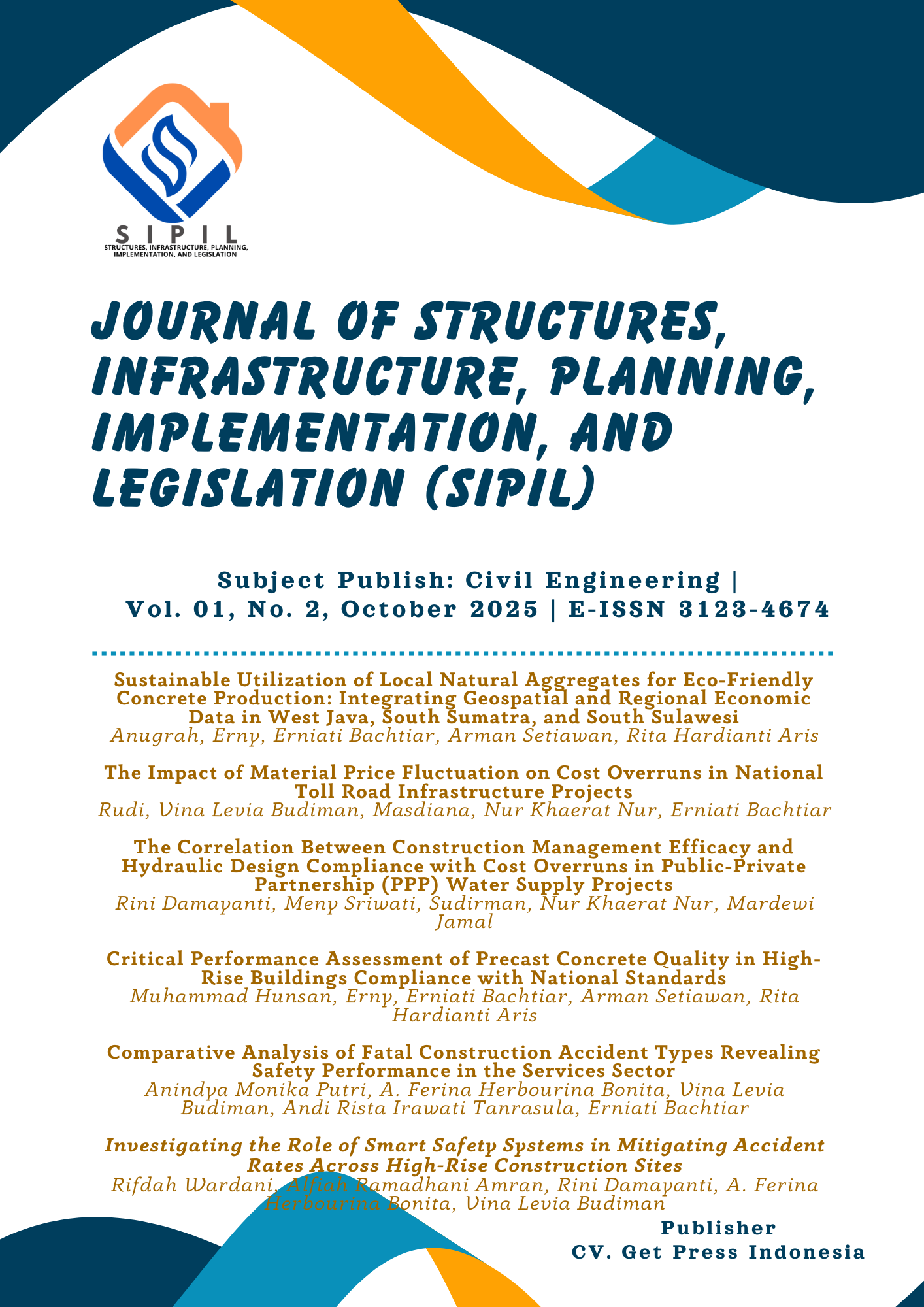
Critical Performance Assessment of Precast Concrete Quality in High-Rise Buildings Compliance with National Standards
DOI:
https://doi.org/10.69855/sipil.v1i2.315Keywords:
Precast Concrete, High-rise Buildings, Quality Control, SNI Compliance, Seismic PerformanceAbstract
This study critically assesses Precast Concrete (PC) quality compliance in Indonesian high-rise buildings by comparing material strength, geometric tolerances, and seismic connection performance against SNI requirements. Using five years of official inspection data (2020–2025) from 120 certified lots (BSN/PUPR), the analysis identifies recurring non-compliance, including a 15.0% compressive strength defect rate, 8.5% AOQ, and 17.1% reinforcement cover deficiencies that may compromise structural durability. Wet joints exhibit better seismic resilience (μ = 4.5) than dry joints (μ = 3.8), though dry joints show pinching effects that reduce energy dissipation.Key root causes include moisture instability, admixture dosing errors, and precision gaps, revealing a persistent mismatch between documented procedures and actual statistical quality control. The study recommends implementing automated QC systems and strengthening SNI certification through more rigorous statistical approaches. Future work should integrate machine-learning predictive models using real-time factory data to enhance defect prevention.
References
Al-Haddad, R. (2020). Mechanics of slip and pinching behavior in grouted mechanical splice connections under cyclic loading. Journal of Earthquake Engineering, 24(1), 125–140. https://doi.org/10.1080/13632469.2020.170001
Ghosh, P., & Ray, A. (2023). Rethinking quality control: Moving beyond random sampling to continuous process monitoring in precast concrete. Construction Management and Economics, 41(6), 550–565. https://doi.org/10.1080/01446193.2023.221102
Johnson, A., & Lee, B. (2023). Non-destructive testing techniques for quality verification of grout in precast grout-sleeve connections. Magazine of Concrete Research, 75(4), 210–225. https://doi.org/10.1680/jmacr.22.00345
Li, Z., Chen, H., & Wang, J. (2021). Correlation between concrete cover deviation and chloride penetration rate in marine environments. Cement and Concrete Composites, 124, Article 104278. https://doi.org/10.1016/j.cemconcomp.2021.104278
Ma, Z., Liu, Y., & Li, J. (2023). Review on automated quality inspection of precast concrete components. Automation in Construction, 154, 104828. https://doi.org/10.1016/j.autcon.2023.104828
Martinez, R. (2020). The critical impact of aggregate moisture fluctuation on the batching precision of high-strength concrete. Materials and Structures, 53(4), Article 105. https://doi.org/10.1617/s11527-020-01538-4
Nowak, K., Półka, M., & Półka, M. (2023). Statistical quality inspection methodology in production of precast concrete elements. Springer. https://doi.org/10.1007/978-3-031-15822-6
Pinto, P., & Kunnath, S. (2021). Seismic performance of precast concrete systems: An Eurocode-based comparison of wet and dry joint detailing. Journal of Structural Engineering, 147(9), Article 04021183. https://doi.org/10.1061/(ASCE)ST.1943-541X.0003194[3]
Rodriguez, M. (2021). Aligning national building standards with product performance metrics: A policy framework for the construction sector. Policy and Regulation Review, 8(4), 301–315. https://doi.org/10.1108/PRR-05-2021-0021
Sacks, R., & Ramy, A. (2020). Integrating laser scanning and BIM for automated quality assurance and quality control in precast construction. Automation in Construction, 110, Article 103043. https://doi.org/10.1016/j.autcon.2019.103043
Skrzypczak, I. (2023). Statistical quality inspection methodology in production of precast concrete elements. Materials, 16(1), 431. https://doi.org/10.3390/ma16010431
Smith, A., & Jones, B. (2022). Optimizing quality parameters and acceptance sampling in factory-controlled concrete production. International Journal of Production Research, 60(17), 5600–5615. https://doi.org/10.1080/00207543.2021.2001555
Tadepalli, P., Prasad, A. V. S., & Rao, A. S. (2023). Seismic performance of precast concrete connections: A state-of-the-art review. Structures, 47, 100–115. https://doi.org/10.1016/j.istruc.2022.11.050
Wang, F., Zhang, H., & Li, M. (2024). A BIM-based framework for life cycle quality management of precast concrete members. Automation in Construction, 157, Article 105151. https://doi.org/10.1016/j.autcon.2023.105151
Zhou, L., & Han, Q. (2022). Energy dissipation capacity analysis of wet versus dry precast beam-column joints under cyclic loading. Engineering Structures, 252, Article 113645. https://doi.org/10.1016/j.engstruct.2021.113645
Downloads
Published
How to Cite
Issue
Section
License
Copyright (c) 2025 Structures, Infrastructure, Planning, Implementation, and Legislation

This work is licensed under a Creative Commons Attribution 4.0 International License.